 |
| Herring gull mobbing a white-tailed eagle. Credit: Markus Varesvuo/naturepl.com. |
The situation: The breeding season, a mad-as-hell gull defending eggs or chicks, a gigantic maurading scavenger.
|
| Herring gull mobbing a white-tailed eagle. Credit: Markus Varesvuo/naturepl.com. |
 |
| Northern gannet. Credit: Alan D. Wilson via Wikimedia Commons. |
 |
| Winter positions of northern gannets from 4 of 6 North American colonies, where adults and chicks were banded and adults and juveniles tracked. Mean winter (Jan�Feb) positions from adults carrying GLS (2004�2010) and final positions from 18 juveniles with PTTs (2008�2010). Deepwater Horizon site (star) and associated slicks (grey) indicated. Credit: William Montevecchi, et al. Biology Letters. DOI: |
Most adult gannets had returned to Canadian colonies by 20 April 2010, although more than 50,000 immature gannets were in the Gulf at the time and suffered oil-related mortality. Hence, two probable outcomes are (i) a lagged (likely difficult to detect) population decrease or (ii) mortality will be buffered by age-related life-history processes.
 |
| A bonded pair of northern gannets. Credit: Al Wilson via Wikimedia Commons. |
Extrapolation from band recoveries indicates that 13,318 adult gannets winter in the Gulf of Mexico, much less than the 66,124 estimate based on GLS data... PTT positions suggest an estimated population of 52,509 immature gannets in the Gulf compared with 41,587 extrapolated from banding recoveries. Extrapolating tracking data for all gannet age classes more than doubles the estimated number of birds using the Gulf, from 54,905 to 118,633 birds.
 |
| Oiled gannet washed ashore on Cape Cod. Credit: Dennis Minsky at SeaNet. |
Seabirds are among the most obvious and immediate indicators of wildlife and environmental damage during marine pollution events. In these circumstances, seabird mortality has been assessed by counting dead and dying animals along coasts. These assessments are biased towards animals that die near accessible well-populated coastlines, and as offshore winds and currents can reduce coastal-deposition of carcasses that sink after a few days, mortality is inevitably underestimated.
 |
| Northern gannet in flight. Credit: Andreas Trepte via Wikimedia Commons. |
In April 2011, at their southernmost colony, Cape St. Mary's Newfoundland, gannets on inaccessible cliff-sites were observed and photographed with dark soiled plumage that looked like oil, but this could not be verified by chemical analysis. Tracking, survival and physiological measurements at gannet colonies during 2011 are evaluating other potential repercussions and informing management about conservation concerns.
 | |
|
UPDATE: 22:07 GMT, 9 OCT 2011: New Zealand's MetService has issued a severe weather watch for the Bay of Plenty, with strong northeasterly gusts and heavy rains possible in the region today [Monday, New Zealand time]. Officials are advising that oil will start reaching shore at Bay of Plenty's Papamoa beach on Wednesday. Questions remain as to why the large ship hit a well-documented reef in calm waters.
More resources and special equipment [are] likely to be needed during the operation. An offshore boom barrier device to ring-fence the oil�measuring about 1250m [three-quarters of a mile]�was being transported from Australia along with three heavy skimmers to scoop it from the water. A salvage architect was due to arrive from Holland, with further expert help from the Australian Maritime Safety Authority also on their way.
 |
| Site of the grounding of the MV Rena, off the North Island of New Zealand. Satellite image courtesy of NASA/JPL/NGA. |
"It's a very difficult situation and the reality is that we are going to see a significant oil spill," [Transport Minister Steven] Joyce said. "So far it's been reasonably small, so I think everybody's preparing for the worst. We are dealing with a very serious situation ... and I don't think anybody is under any illusions."
klepto: Greek ???pt?? ("thief") and ???pt? ("steal") + parasitos: pa??s?t?? ("person who eats at the table of another")




Depending on wind strength, take-off may be difficult, requiring a long run with the head outstretched, the bird flapping its wings and literally running. Take off from water is similar, requiring furious paddling with the webbed feet. Landings can be equally difficult, especially in birds that have been at sea for months, or in light winds. In the absence of the braking effort of a strong wind, landing birds may occasionally tumble on landing.


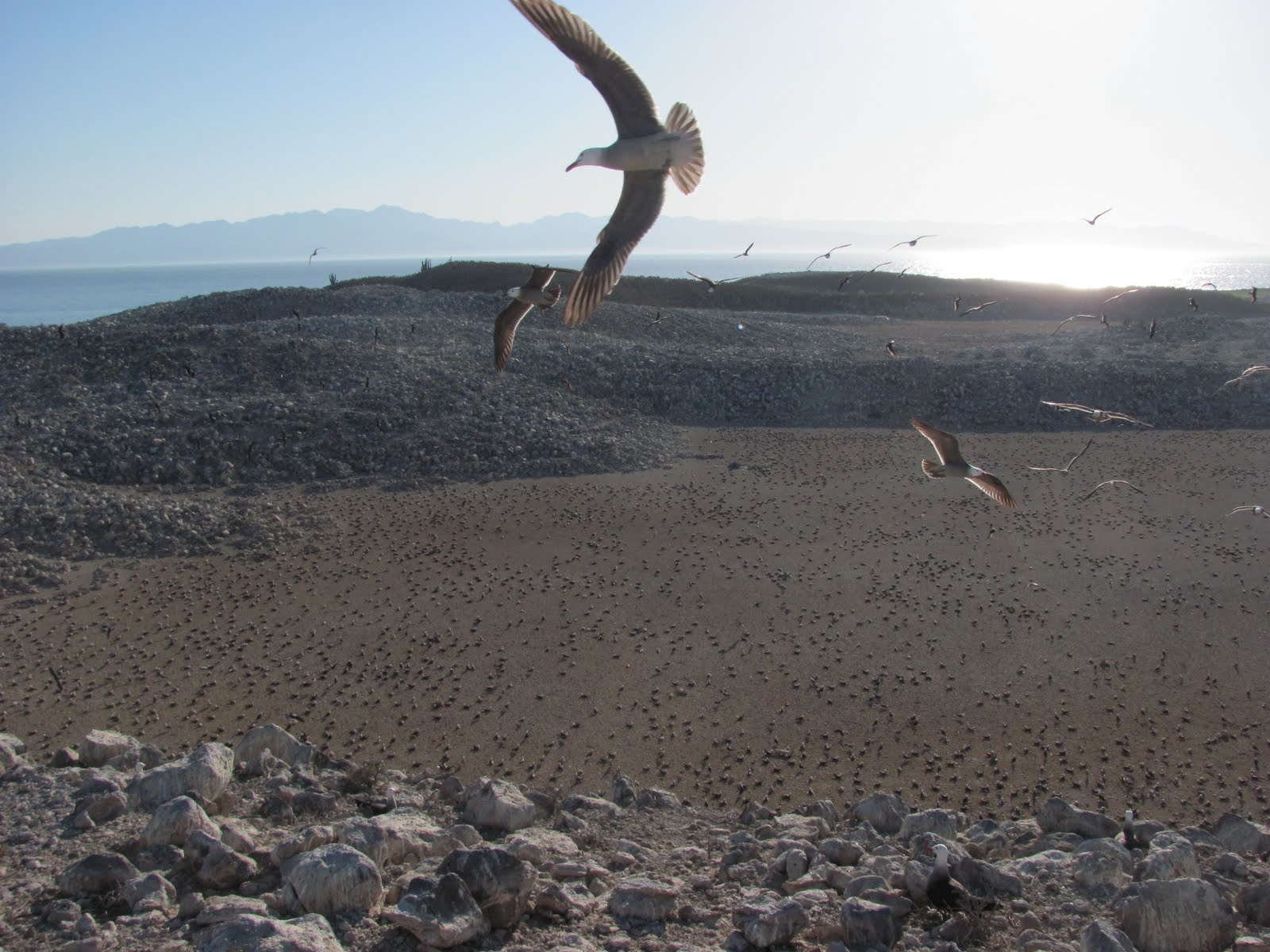
Enriqueta has returned to Rasa every spring to live among the birds. She has become one of the foremost voices for the preservation of the wild islands of the Gulf of California. Her presence, her deepening knowledge, have protected this corner of the world far beyond the modest funding she receives.

Over more than 30 years of scientific work Dr. Velarde has contributed significantly to the recovery of Rasa Island, one of the most unique ecosystems in the world, located in the Gulf of California... In the early seventies the population of gulls and terns amounted to a few tens of thousands. Today, as a result of the actions and the presence of Dr. Velarde, the number of birds that nest each year on the island is about half a million, its density is so high that have begun to nest on nearby islands.

 (Streaked shearwater. Photo by marj k Marj Kibby, at Flickr.)


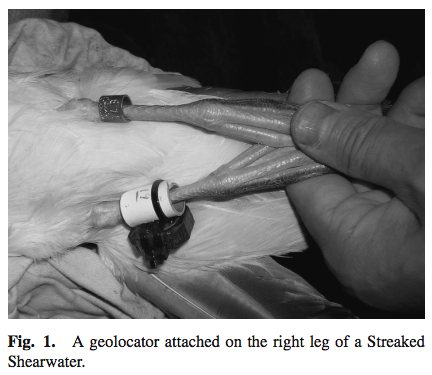
Most Streaked Shearwaters wintered off northern New Guinea, an area of low primary productivity but high Skipjack Tuna (Katsuwonus pelamis) abundance. Streaked Shearwaters flew for longer periods and landed on the water more frequently around dawn and dusk during the wintering period. This pattern of activity is similar to that of subsurface predators such as tuna, and to that of tropical seabirds that are known to feed with subsurface predators. We suggest that Streaked Shearwaters probably forage in association with subsurface predators in the tropical oceans during the wintering period. Foraging in association with subsurface predators and morphological adaptations for gliding may allow Streaked Shearwaters to forage efficiently in both temperate and tropical environments.
 (Sooty shearwaters. Photo by marlin harms, courtesy Wikimedia Commons.)

Electronic tracking tags have revolutionized our understanding of broad-scale movements and habitat use of highly mobile marine animals, but a large gap in our knowledge still remains for a wide range of small species. Here, we report the extraordinary transequatorial postbreeding migrations of a small seabird, the sooty shearwater, obtained with miniature archival tags that log data for estimating position, dive depth, and ambient temperature. Tracks (262 � 23 days) reveal that shearwaters fly across the entire Pacific Ocean in a figure-eight pattern while traveling 64,037 � 9,779 km roundtrip, the longest animal migration ever recorded electronically. Each shearwater made a prolonged stopover in one of three discrete regions off Japan, Alaska, or California before returning to New Zealand through a relatively narrow corridor in the central Pacific Ocean. Transit rates as high as 910 � 186 km�day-1 were recorded, and shearwaters accessed prey resources in both the Northern and Southern Hemisphere�s most productive waters from the surface to 68.2 m depth.But now the flying record of the sooty shearwaters been topped by a diminutive seabird, the Arctic tern, who not only crosses hemispheres but ocean basins as well.


