Tampilkan postingan dengan label history. Tampilkan semua postingan

Rabu, 19 Oktober 2011

LIFE AND DEATH OF A SEA STACK

1890

   
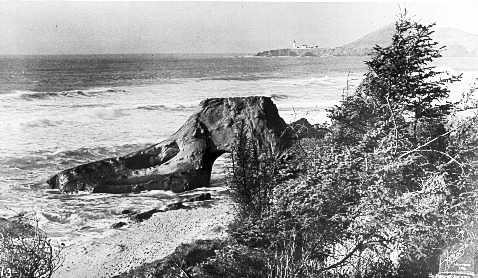
Jump-off Joe was a 100-foot-/30-meter-tall sea stack near Nye Beach, Oregon�named because visitors had to jump off its steep side to get around it.

Before the 1880s it was still attached to the mainland. Around 1890 its connection fell away. From then until World War I it was a well-known tourist attraction.

These undated postcards show part of its lifecycle.


The rock formation was subject to rapid erosion and returning visitors would make a point of checking out the changes since their last visit... The arch finally collapsed during a severe storm in late January, 1916.

Or not. The following photographs, courtesy of the USGS, suggest that Jump-off Joe survived as an arch at least until 1920, then in ever-diminishing incarnations until the 1990s. (H/T Irish Weather Online.)
1910

1920

1970

1990

  
As an interesting aside�near my home in northern California there are a few old uplifted sea stacks that now stand high and dry on coastal terrace.

Photo by tuolumne tradster via Flickr.


These ancient stacks bear areas of highly-polished mirrorlike rock, which have have been analyzed by archaeologists using scanning electron microscope and atomic force microscope, then compared with wave polish from cliffs below the terrace, with elephant rubs, and with just about every other form of rock polish. 

Their conclusion: woolly mammoths rubbed here. 

From the paper: 

In eastern and southern Africa, rubbing stones are relatively common in the savanna and grassland areas. They stand as monuments to ancient itches... Stack 1 in our study area is adjacent to a [freshwater] seep which has probably been active throughout the Pleistocene. The modern Asian elephants and African elephants especially like to rub on trees and rocks after wallowing in mud. Ectoparasites encased in the drying mud are removed by the rubbing action which benefits the animals. It is possible that the seep was an animal wallow which encouraged the use of the adjacent rocks, and caused their high polish over a matter of perhaps a hundred thousand years.

Mammoth rubbing rocks. Photo: � Julia Whitty.


The paper:

  • E Breck Parkman, et al. Extremely High Polish on the Rocks of Uplifted Sea Stacks along the North Coast of Sonoma County, California, USA (pdf).  

    Woolly mammoth at the Royal British Columbia Museum. Photo: WolfmanSF via Wikimedia Commons.

    Senin, 26 September 2011

    HAECKEL'S OCEAN

    Actiniae [sea anemones]


    Prosobranchia [archaic: snails]


    Acsidiae [sea squirts]


    Cyrtoidea [archaic: radiolarians]


    Chaetopoda [archaic: segmented worms]


    Hexacoralla [corals & allies]


    Gamochonia [archaic: cephalopods]


    Decapoda [crustacean]


    Ostraciontes [boxfishes & allies]


    Diatomea [diatoms]


    Discomedusae [archaic: jellyfish]


    Ophiodea [brittle stars]


    Cubomedusae [archaic: box jellyfish]


    Excerpted from Wikipedia:

    Ernst Heinrich Philipp August Haeckel (16 February 1834-9 August 191) was an eminent German biologist, naturalist, philosopher, physician, professor, and artist who discovered, described and named thousands of new species, mapped a genealogical tree relating all life forms, and coined many terms in biology, including anthropogeny, ecology, phylum, phylogeny, stem cell, and the kingdom Protista. Haeckel promoted and popularized Charles Darwin's work in Germany and developed the controversial recapitulation theory ("ontogeny recapitulates phylogeny") claiming that an individual organism's biological development, or ontogeny, parallels and summarizes its species' evolutionary development, or phylogeny.
    The published artwork of Haeckel includes over 100 detailed, multi-colour illustrations of animals and sea creatures (see: Kunstformen der Natur, "Art Forms of Nature"). As a philosopher, Ernst Haeckel wrote Die Weltr�tsel (1895�1899, in English, The Riddle of the Universe, 1901), the genesis for the term "world riddle" (Weltr�tsel); and Freedom in Science and Teaching to support teaching evolution.
    In the United States, Mount Haeckel, a 13,418 ft/4,090 m summit in the Eastern Sierra Nevada, overlooking the Evolution Basin, is named in his honor, as is another Mount Haeckel, a 2,941 m/9,649 ft summit in New Zealand; and the asteroid 12323 Haeckel.

    All plates from Ernst Haeckel's Kunstformen der Natur, courtesy of Wikimedia Commons.

    Sabtu, 24 September 2011

    CHOWDER WORTH SURFACING FOR


    And here's the story of Ivar's chowder from a 2009 article in the Seattle Times:

    He has been called the greatest self-promoter in the history of Seattle. And now, more than 24 years after he died at age 79, Ivar Haglund apparently has managed one more fantastic stunt. Underwater billboards that date to around 1954. Anchored to the bottom of Puget Sound with concrete footings. Yes, at the bottom of Puget Sound. At around 55 to 80 feet in depth, depending on the tide, and near the shore. You know, just in case you were in a personal submarine cruising along Elliott Bay, or Edmonds, or Alki Point. There they would be:
    "Ivar's Chowder. Worth surfacing for. 75� a cup."
    Or, "Diver's special. Kids 12 & Under Eat Free* with regular entr�e. Includes Jell-O."
    There apparently were plans for seven underwater billboards. In the past month, the company has had divers bring up three of the billboards�about 7 by 22 feet and made of stainless steel�using a map found in their founder's immense collection of artifacts stored on the top floor of the chain's headquarters at Pier 54...
    "This still could be a hoax. Someone could be doing something," says Bob Donegan, president of Ivar's. "That's why we're being careful on the authentication"...
    Seattle historian Paul Dorpat also says he doesn't believe the billboards are hoaxes. If anyone should know about Ivar Haglund, it is Dorpat. He is writing a book about Haglund, and interviewed him a number of times. Dorpat also has been granted access to all of Haglund's archives. "As far as I can tell, it's the real thing," says Dorpat about the papers documenting Ivar's plans for the billboards. It was Dorpat who found the documents. Dorpat remembered a poem that Haglund likely wrote in the mid-1950s that celebrated cross-sound submarine passenger service, with lines that included:
    "As we go ping-ping-pinging along, We sing our happy song, Up periscope down down down, We're diving in Puget Sound... "
    Ivar, obviously, was a man with vast imagination.

    Underwater Americana at its best.

    UPDATE: Thanks to Sam for pointing out it was a hoax. Neverthess, primed by Ivar's, I ate chowder the night this was posted.


    Rabu, 20 Juli 2011

    THE MEMORIES OF OLD FISHERS

    There's an interesting paper just out in PLoS ONE assessing whether or not the memories of old fishers could be useful to science. Specifically, whether their recollections correlate with other fisheries data from recent decades.

    The authors write:

    Population declines and the extinction of marine organisms may be largely underestimated due to the difficulties involved in making scientific observations. However, data sources other than scientific time-series have proven useful in providing relevant information to marine scientists in cases that are normally considered "data-poor." Some studies have used traditional (or local) ecological knowledge to reconstruct temporal population trends and discover near-extinctions of marine fauna, while studies that compare the results from scientific research with evidence based on fishers' experience have shown that both sources of knowledge give similar results and can be used to detect the essential trends.

    (Photo above by Steve Evans via Wikimedia Commons.)

    (Monk seal. Via.)

    To investigate, the researchers delved into the memories of 106 retired trawl fishers in Italy, Spain and Greece, seeking their impressions of the abundance of long-lived marine species�dolphins, whales, monk seals, marine turtles, and sharks�in the Mediterranean.

    During the interviews, the old dudes (pretty sure they were all dudes) were asked to rank abundance of these animals group during three 20-year periods between 1940 and 1999.
     
    Their perceptions were based on two indicators:

    • Frequency of sightings
    • Frequency of catches (incidental or intentional) 

      (Via.)

      Specifically, they were asked about:

      • Intentional catches of dolphins 
      • Intentional catches of turtles
      • Sightings of dolphins, whales, seals, or turtles
      • Relative catches of sharks/cartilaginous fishes

      Their answers could be: "never," "occasional," "frequent," or "very frequent."


      (Trends in catches and sightings of large marine fauna, all areas combined. Credit: Francesc Maynou, et al. PLoS ONE. DOI:10.1371/journal.pone.0021818.t001. Larger view here.)

      The results were interesting. And sad.

      • The frequency of encounters between large marine fauna and fishers declined throughout the latter half of the 20th century.
      • The decline continues at the beginning of the 21st century (except in Greece, where some dolphins are experiencing population increases).  
      • The commercial catches of sharks and other cartilaginous fishes decreased significantly.  

      The authors note that the abundance of monk seal and whales was already so low in the 20th century that the interview data were insufficient for a quantitative analysis.
        
      (Angelshark. Photo by Philippe Guillaume via Wikimedia Commons.)

      Here's what the fishers' memories revealed about recent extinctions:

      [S]moothhounds Mustelus mustelus [a kind of shark] are likely to have disappeared in the Catalan Sea before 1979, and angelsharks Squatina squatina before 1959. In western Italy, angelsharks would have disappeared by the early 1980s near the mainland and the mid-1980s in Sardinia. Smoothhounds became functionally extinct in 1990 in Italy and Greece, with only sporadic records thereafter. The sturgeon Acipenser acipenser had become extinct in the North Adriatic by 1966.


      (Photo by catrien via Flickr.)

      Bottom line is that fishers are good observers and a largely untapped treasure trove of fish tales about the health of marine ecosystems.

      If we accept that commercial trawl fishers are independent observers of the marine system, [our] results suggest that the abundance of large marine fauna has decreased considerably during the 20th century in the Mediterranean Sea (in agreement with the results of other studies), and therefore fishers' observations during a lifetime of professional activity can provide a qualitative measure of this decline.

      (Photo via.)

      Fish tails welcome too.

      ResearchBlogging.org

      Maynou, F., Sbrana, M., Sartor, P., Maravelias, C., Kavadas, S., Damalas, D., Cartes, J., & Osio, G. (2011). Estimating Trends of Population Decline in Long-Lived Marine Species in the Mediterranean Sea Based on Fishers' Perceptions PLoS ONE, 6 (7) DOI: 10.1371/journal.pone.0021818

      Kamis, 30 Juni 2011

      RIGHT WHALES DECODED

      (Southern right whale. Credit: � Brian J. Skerry / National Geographic Stock. Via the World Wildlife Fund.)

      An interesting new paper in MEPS (Marine Ecology Progress Series) on the southern right whales of New Zealand and Australia.

      Background: All right whales, north and south, were taxed hard and early by human whalers�the "right" whales to hunt because their high blubber content made them likely to float after death and because they frequented near-shore waters.

      That made them easy to get to even in the days of rowing.

      (A painting, artist unknown, showing the hunting of right whales. La Baleine. The Whale, circa 1840. Credit: Wikimedia Commons.)

      Some 150,000 Southern Hemisphere right whales (Eubalaena australis) were killed by 19th-century whalers and by illegal 20th-century Soviet whalers�driving the species to the brink of extinction.

      Around Australia and New Zealand, hunting peaked in the 1830s-1840s, after which the species was commercially extinct.


      (Geographic range of the southern right whale. Via the Red List.)

      The latest IUCN estimate of southern right whales dates back to 1997 when they calculated a population of 7,500 individuals. 

      At that time, several breeding populations (in Argentina/Brazil, South Africa, and Australia) showed evidence of strong recovery, with a doubling time of 10-12 years.

      Which means there might be a fair few more than 7,500 whales today.


      (Southern right whale with calf. Credit: John Atkinson. Via Marine Science Today.)

      According to the authors of the MEPS paper, no right whales were seen in the waters around mainland New Zealand for 35 years between 1928 and 1963. A few slowly returned. Yet as recently as 2005 less than 12 sexually mature females were found there.

      But another group, known as the New Zealand subantarctic group, has a more robust population estimated at about 936 whales today. Forebears of this group were likely present in some small numbers even in the bleakest killing years.


      (Credit: E. Carroll, et al, via MEPS.)

      The authors of the MEPS paper wondered about the levels of relatedness between those two whale stocks in New Zealand, as well as among whales in Australia.

      They used mitochondrial DNA and microsatellite genotypes to identify 707 individual whales and test them for genetic differentiation. You can see the breakdown of that analysis in the graphic above.

      Their data, combined with historical evidence, led the researchers to hypothesize that individuals from the NZ subantarctic are slowly recolonizing mainland New Zealand waters, where a calving ground was obliterated in the 19th century.


      (Southern right whale. Via.)

      The genetic evidence also suggests that the whales of southeast Australian are a remnant stock�different from the whales of southwest Australia:


      At the onset of whaling, southern right whales, in particular cows with calves, were found across the southern coast of Australia during the austral winter (IWC 1986). There was no real discontinuity in distribution or catch records to suggest subdivision of calving grounds in this region (IWC 1986). Based on the timing of catches at shore whaling stations during the 19th century, Dawbin (1986) proposed that southern right whales undertook 2 distinct patterns of migration along the southern coast of Australia during the austral winter. The southern right whales that migrated north along the east coast of Tasmania [the small island off the southeast tip of Australia, as seen in the graphic above] moved in a northeasterly direction up the coast of Victoria and New South Wales, while those that migrated north along the west coast of Tasmania moved from east to west along the southern coast of South and Western Australia. The latter pattern is still extant, based on the movement of photo-identified southern right whales and has been termed the 'counter-clockwise' migratory pattern (Kemper et al. 1997, Burnell 2001).


      (The Southern Ocean. Credit: Connormah via Wikimedia Commons.)

      They also found evidence that New Zealand and Australian right whales mingle in higher-latitude summer feeding grounds each austral spring�making the health of those cold Southern Ocean waters as important a component of recovery as the whales' breeding efforts.

      And what epic efforts they are. Imagine a 12-foot-long penis�known colloquially as a sea snake�plus a tons' worth of testes per male. Mating becomes a sport of endurance. And sperm competition.

      But you don't have to imagine it. As usual, just for us, David Attenborough respects the privacy of none.


      ResearchBlogging.org

      Carroll, E., Patenaude, N., Alexander, A., Steel, D., Harcourt, R., Childerhouse, S., Smith, S., Bannister, J., Constantine, R., & Baker, C. (2011). Population structure and individual movement of southern right whales around New Zealand and Australia Marine Ecology Progress Series DOI: 10.3354/meps09145